Confined Space Program
Program name | Confined space program |
Owners | Microsoft Global Occupational Health and Safety |
Revision date | Revision C, November 29, 2022 |
Effective date | Revision C, November 29, 2022 |
The controlled version of this document can be found on the Global OHS website at aka.ms/SafetyHubPrograms. Printed copies may be out of date and should be destroyed or marked as archived immediately after use.
Senior Management endorses this Program. This document applies to all Microsoft employees and interns. This program also applies to external staff who are supervised directly by Microsoft employees and who work at a Microsoft worksite. Any violation of this Program may lead to disciplinary action up to and including termination of employment. In some cases, a violation of this Program may also violate international, federal, state, and/or local law. In such cases, Microsoft and/or the individual could be subject to civil or criminal liability.
Table of Contents
5.0 Roles and Responsibilities
Appendix A: Sample Confined Space Plan Outline
Appendix B: Atmospheric Monitoring
Appendix C: Permit Required Confined Space Decision Flow Chart
Appendix D: Example Confined Space Entry SOP
Appendix E: Confined Space Permit
Appendix F: Rescue Team or Rescue Service Evaluation Criteria
1.0 Purpose and Scope
Microsoft establishes the Confined Space Program for compliance with applicable regulations such as OSHA, 29 CFR 1910.146, Permit Required Confined Spaces. Additional state and local regulations may apply. The Confined Space Program:
- Provides information to employees on the identification, evaluation, and control of confined space hazards.
- Helps to ensure that employees and external staff who must enter such spaces are trained and understand the requirements defined in this Program.
- Contains criteria for identifying and classifying confined spaces, including permit required confined spaces.
- Establishes the standard precautions and procedures that must be implemented to control potential hazards during entry.
This program applies to all Microsoft operations that require entry into permit required or nonpermitted confined spaces. Confined spaces at Microsoft may include but are not limited to testing chambers, tanks, ducts, pipelines, sumps, sewers, plenums, and vaults. Entry into these spaces may be required for constructing, installing, setting up, adjusting, inspecting, modifying, maintaining and/or servicing machines or equipment.
2.0 Program Requirements
2.1 Prevention and Control
2.1.1 Site Confined Space Plan
The Plan Administrator for a Microsoft facility included in the scope of this program must develop a Site-specific Confined Space Plan (Site Plan). The Site Plan must be made available to employees, external staff, or regulatory agency personnel. The Site Plan must include the following:
- Program purpose and scope.
- Applicable federal, state, or local regulatory requirements
- Personnel roles and responsibilities with identification of confined space supervisors, entrants, and attendants by name.
- A Plan Administrator must be designated for each work location to oversee implementation of the Site Plan.
- Definitions of terms critical to an understanding of the program.
- Summary of the workplace survey and hazard assessments
- Entry procedures including general rules for program implementation
- Training and recordkeeping requirements
2.1.2 Hazards
The following table contains descriptions of potential confined space hazards.
WARNING: Hazardous substances that are produced by activities in the general area of a confined space can migrate to, and accumulate in the space, creating an unseen hazard to an unsuspecting entrant.
Hazard | Description | Safety Procedure |
Excess Pressure | Pressure can build up due to chemical reactions of equipment or materials inside a tightly sealed space and create a physical hazard while removing the cover or hatch. | Entry points and hatches should be inspected prior to removal for signs of:
Discoloration
Heat
Damage around the sealing surface |
Atmospheric | Hazardous concentrations of chemicals may build up or be generated in the confined space, posing a respiratory hazard to the entrant. | Use calibrated confined space monitors prior to entry, and continuously during entry, to test for hazardous atmospheres, including:
Oxygen 19.5 to 23.5%
Flammability (% of LEL) < 10%
Carbon Monoxide < 35 ppm
Hydrogen Sulfide < 10 ppm
Specific testing as needed |
Electrical | Confined spaces may contain equipment that poses electrical hazards such as defective cables, water in contact with a source of electricity, or through physical contact with charged cables or wire leads. | Follow requirements in Microsoft
Electrical Safety Program and Microsoft
Control of Hazardous Energy (LOTO) Program |
Engulfment | Engulfment hazards in a confined space are created by conditions that could crush, suffocate, trap, or incapacitate an entrant. | Visually inspect the space prior to entry to evaluate potential engulfment hazards. Control engulfment hazards before entering the space using such devices as trench boxes.
Apply appropriate LOTO procedures if the engulfing material has the potential to enter during work |
Entrant- Generated | Bringing chemicals into the space (such as for cleaning, painting, stripping, or coatings) can create a toxic, flammable, or oxygen deficient atmosphere. Hot work can create additional flammable and ignitable hazards. | Review SOP for entry into the confined space.
Anticipate the hazards associated with the task.
Implement controls to prevent an incident. |
2.2 Confined Space Hazard Assessment
The Site Facility owner will conduct a survey to identify and classify all permit and non-permit required confined spaces present at the Microsoft-owned facilities. The survey must include an inventory of all confined spaces. The complete inventory includes documentation of the following:
- Identification of each space by unique identifying number
- Photograph(s) of entry points or exterior hazards for each space
- Determination of non-permit/permit-required classification for each space.
- Identification of unique hazards found in the space that need to be mitigated or controlled before entering the space.
- Historical information, if available, of atmospheric monitoring.
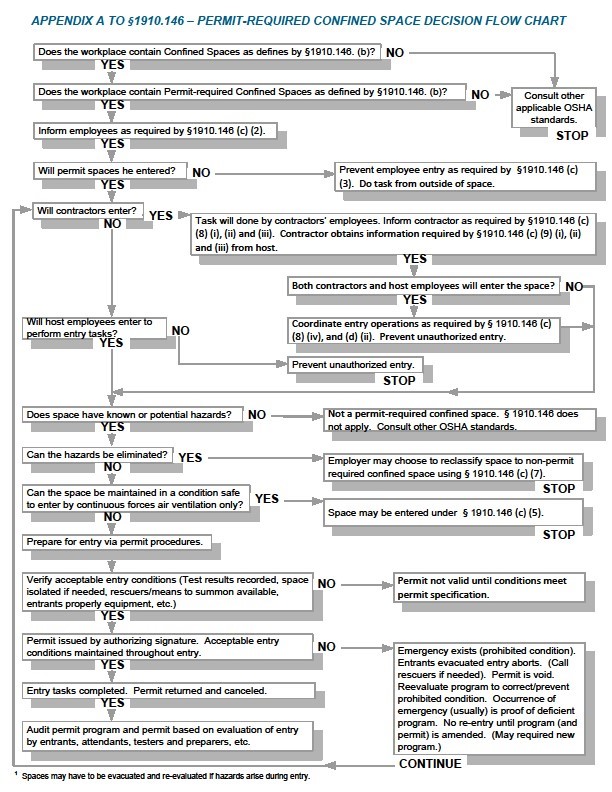
Based on the hazard assessment, the Plan Administrator will determine whether the space is non-permit or permit required using OSHA’s Permit-required Confined Space Decision Flow Chart (Appendix C).
- The Entry Supervisor should develop an entry SOP describing the work to be performed in the space (Appendix D).
- If the Plan Administrator confirms that different confined spaces share identical entry requirements, the same SOP may be re-used for more than one confined space.
2.2.1 Non-Permit Confined Spaces
- A non-permit confined space meets the OSHA definition of a confined space but does not contain any physical or atmospheric hazards nor is there a potential for these hazards to develop.
- If the potential for a hazardous atmosphere to develop during entry exists, the space cannot be classified as a non-permit confined space.
2.2.2 Permit-Required Confined Space
For a space to be classified as a permit-required confined space it must have one or more of the following characteristics:
- Contains or has the potential to contain a hazardous atmosphere.
- Contains a material that has the potential for engulfing an entrant.
- Has an internal configuration such that an entrant could be trapped or asphyxiated by inwardly converging walls or by a floor which slopes downward and tapers to a smaller cross-section.
- Contains any other recognized serious safety or health hazard.
2.2.3 Reclassification of a Permit-Required Confined Space
- A permit-required confined space may be reclassified as a non-permit confined space as long as the non-atmospheric hazards remain eliminated.
- A permit-required space with atmospheric hazards may not be reclassified.
- Use of ventilation is not sufficient to allow re-classification of the space.
- If entry into the permit-required space is required to eliminate hazards, the entry must be completed under permit-required conditions.
- Once non-atmospheric hazards have been eliminated, the permit-required space may be reclassified as a non-permit confined space for as long as the hazards remain eliminated.
- The Entry Supervisor must verify that all hazards in a permit-required space were eliminated.
- The verification must contain the date, the location of the space, and the signature of the Entry Supervisor. The verification shall be made available to all entrants.
- If hazards arise within a reclassified space, all entrants must exit the space. The Entry Supervisor must reevaluate the space and determine whether it must be reclassified as a permit space.
Contact the Plan Administrator, or Microsoft OHS for more information on reclassifying a permit-required confined space.
2.3 Identification of Confined Spaces
All non-permit and permit required confined spaces must be identified with a danger sign.
- Non-permit spaces will be identified with a signs stating:
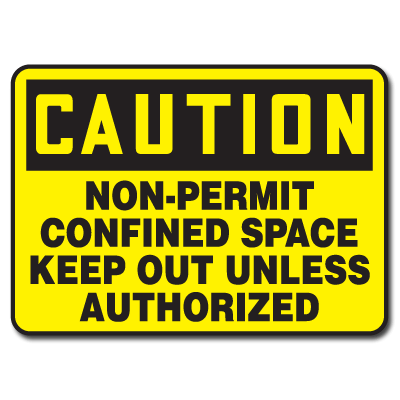
- Permit required confined spaces will be identified with a danger sign that states:
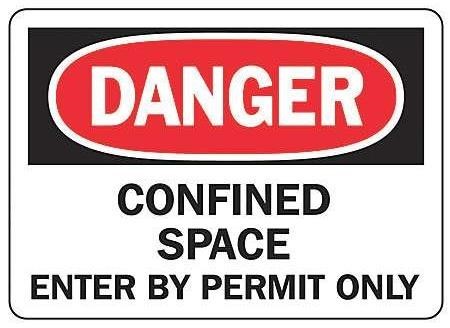
- Confined spaces, whether non-permit or permit required, should be identified by a unique name and documented on the confined space assessment for that unique space.
- New spaces may be added to the inventory, or the hazard assessment may require updating if hazardous conditions change.
- If a space does not have a signed and does not have a documented hazard assessment, the entrant shall not enter the space and should immediately notify the Plan Administrator to determine the proper entry procedures.
2.4 Confined Space Entry
2.4.1 Pre-Entry Requirements for Confined Spaces
A Confined Space SOP must be prepared and reviewed by all Entry Team members before entering a space. The Entry SOP will identify all hazards generated in the course of the work. For an example of an Entry SOP refer to Appendix D.
The Entry Supervisor must complete the following prior to entry:
- Oversee air monitoring performed prior to entry
- Notify the supervisor in charge of the area where the space is located that an entry will take place.
- Review the SOP and previous hazard assessments with the Entry Team members.
- Determine if there have been any changes in the use or configuration of the space that will change its classification.
- Determine if any activities in the area could cause a hazardous atmosphere to build up in the space.
All entrants must adhere to the following:
- Review the Entry SOP and the Confined Space Permit prior to entry.
- Enter the space only under the direction of the Entry Supervisor.
- Never perform activities in the space that could cause a buildup of a hazardous atmosphere without prior authorization.
- Never work alone.
2.4.2 Entry Procedures
An entry has occurred once any part of the body breaks the plane of an opening of a space. This includes an individual body part (e.g., an arm to make a quick adjustment or inserting the head to look inside the space). If any entry occurs, all confined space procedures must be followed.
- Specific entry requirements for each space listed in the SOP must be followed.
- Floor entrance covers that are removed should promptly have the opening guarded by a railing, temporary cover, or other temporary barrier.
- Atmospheric monitoring must be performed.
2.4.3 Entry Permits
A confined space permit, signed by the Plan Administrator, must be posted at all entrances to the space and made available to entrants before entry. See Appendix E for an example of a confined space permit.
- The permit must document that pre-entry preparations have been complete.
- The duration of entry permits must not exceed the time required to complete an assignment or the length of one 8-hour shift, whichever is shorter.
- For entries extending beyond one 8-hour shift, a new permit must be completed and signed by the respective parties involved in the entry.
- Entry permits must include:
- Name of permit space to be entered, authorized entrant(s), eligible attendants and individuals authorized to be entry supervisors.
- Air monitoring results and the tester’s initials or signature.
- Name and signature of entry supervisor.
- Purpose of entry and known confined space hazards.
- Measures to be taken to isolate permit spaces and to eliminate or control confined space hazards.
- Name and telephone numbers of rescue and emergency services and means to be used to contact them.
- Date and authorized duration of entry.
- Acceptable entry conditions.
- Communication procedures and equipment to maintain contact with the entrants during entry.
- Additional permits (i.e., hot work, energized electrical work) issued for the permit-required space.
- Special equipment and procedures, including personal protective equipment and alarm systems.
- Any other information needed to ensure employee safety.
- The Plan Administrator must cancel entry permits when:
- An assignment is completed; or
- When conditions change, such as the completion of a work shift or introduction of a hazard into the space.
- New conditions must be noted on the canceled permit and used in revising the permit.
- All canceled entry permits must retain for at least one year
2.5 Entry Team
2.5.1 Entry Supervisors
Entry supervisors are responsible for maintaining safe working conditions for the entrant and attendant while a confined space entry is occurring. The entry supervisor must:
Prior to entry
- Know about the hazards that may be faced during entry, including the mode, signs or symptoms, and consequences of the exposure.
- Verify and check all of the following prior to entry:
- Authorized members of the entry team are present.
- The appropriate entries have been made on the permit.
- All tests specified by the permit have been conducted. Attendants and entrants must have the opportunity to observe air monitoring.
- Rescue services are available and means of contact verified.
- Establish and confirm communication methods between attendant, entrant and emergency services.
- All equipment specified by the permit is in place.
- Users are trained on the SOP.
- Authorize the entry into a permit-required confined space by acquiring, reviewing, completing, and signing the entry permit. During entry operations.
- Oversee entry operations.
- Remain at the site during all entry procedures.
- An entry supervisor may oversee multiple entries at one time as long as the spaces are within visual range.
- Prohibit untrained, unauthorized individuals from entering or attempting to enter the permit-required confined space.
- Verify that the space remains safe for entry at regular intervals as dictated by the SOP.
- Terminate the entry and cancel the permit when:
- The assigned task or job has been completed.
- Conditions not covered by the permit are found.
- A condition covered by the permit and controlled before entry poses a hazard.
- Work continues past the time allocated on the permit without the authorization of the Plan Supervisor.
- Determine that entry operations remain consistent with the terms of the entry permit and acceptable entry conditions are maintained whenever responsibility for a permit-required space entry operation is transferred. If the entry operation is transferred, a new permit must be completed and signed.
After completing entry
- Complete entry permit and return to the Plan Administrator.
- Ensure that the confined space is secure, any hazards have been eliminated, and equipment used for entry is in good working order and returned to the proper storage place.
- Any equipment not in proper working order must be red-tagged with “Do Not Use” and repaired or replaced.
2.5.2 Entry Attendants
The number of attendants assigned should be tailored to the requirements of the space and the work performed. A confined space entry attendant must:
- Support only one confined space entry at a time. Attendants may not oversee more than one confined space simultaneously.
- Understand the hazards that may be faced during entry, including the mode, signs or symptoms, and results of exposure to the hazards.
- Carry out no additional duties that might interfere with monitoring and protecting the entrants.
- Continuously maintain an accurate count of entrants in the space.
- Communicate with entrants as necessary to monitor their status or alert them of the need to evacuate the space.
- Monitor activities inside and outside the space to determine if it is safe for entrants to remain in the space.
- Order entrants to evacuate the space immediately if any of the following conditions occur:
- A prohibited condition arises, such as an exceedance of acceptable atmospheric levels or failure of air monitoring instrumentation.
- The entrant exhibits behavior indicative of a hazardous atmosphere or other exposure.
- A situation occurs outside the space that could endanger entrants.
- The attendant cannot effectively and safely perform all their assigned duties.
- Warn unauthorized persons to stay away from the space.
- Perform non-entry rescues only as specified by the Confined Space Permit.
- Call for rescue and other emergency services as soon as entrants may need assistance to escape from the space.
- Monitor entry operations until relieved by another attendant or all entrants have exited the space.
2.5.3 Entrants
Confined space entry supervisors must ensure that all entrants:
- Review and understand the SOP and confined space entry permit.
- Know the hazards they may face during entry, including:
- Methods of exposure to a hazard.
- Signs or symptoms of the hazard.
- Results of exposure to the hazards.
- Have the opportunity to observe air monitoring.
- Use equipment and PPE properly.
- Communicate with the attendant as necessary so the attendant can:
- Monitor entrant status.
- Alert entrants of the need to evacuate.
- Alert the attendant whenever the following situations exist:
- A warning sign or symptom of exposure to a hazardous condition.
- A prohibited condition.
- Exit from the permit-required confined space as quickly as possible when one of the following occurs:
- The attendant or entry supervisor gives an order to evacuate.
- The entrant recognizes any warning sign or symptom of exposure to a hazardous situation.
The entrant detects a prohibited condition. An evacuation alarm is activated. Procedures for responding to and reporting an incident.
2.6 Emergency Rescue Procedures
If the confined space monitor goes into alarm or another situation arises that warrants an evacuation:
- The attendant and supervisor must ensure the entrants are immediately alerted, of hazards outside the confined space. If the hazard is inside the confined space, the entrant should notify the attendant immediately.
- The entrant should calmly and immediately exit the space under the supervision of the attendant and the entry supervisor.
- If the entrant is faced with an emergency where they are unable to self-rescue, the entry supervisor should initiate rescue procedures.
WARNING: It is crucial that members of the confined space entry team do not attempt to rescue an entrant in emergency situations to prevent further injuries, illness, or fatalities.
Each location must have a designated emergency rescue team that is trained and qualified to perform confined space rescues in both permit and non-permit spaces.
- The Plan Administrator will develop and implement procedures for:
- Summoning rescue and emergency services.
- Rescuing entrants from permit spaces.
- Providing necessary emergency services to rescued employees, and for preventing unauthorized personnel from attempting a rescue.
- The rescue team must meet the requirements of OSHA, 29 CFR 1910.146, Appendix F (Non-Mandatory) – Rescue Team; or Rescue Service Evaluation Criteria (Appendix G).
- If a local Fire Department has been chosen as the Rescue Team, the Plan Administrator must contact the Fire Department to confirm:
- They are able to support rescue operations; and
- Are aware of the unique hazards of the spaces on site.
Location specific procedures must be included in the Site Plan.
2.7 PPE
Before determining the appropriate PPE for the specific task, refer to the Microsoft Personal Protective Equipment Program. The Plan Administrator must work with managers to complete a hazard assessment for each space, which will identify the hazards and select the most appropriate type of hazard controls. The hazard assessment should include hazards from atmospheric conditions, energy sources, and other hazards for the specific work task.
2.8 Confined Space Training
Employees, external staff, vendors or contractors authorized to supervise, attend, or enter confined spaces, must be properly trained. Confined space training is required for authorized personnel prior to initial assignment and retrain if any of the following occur:
- Changes in procedures.
- Changes in work assignments.
- New hazards arise in the work place.
- An accident, incident, or near mishap occurs related to confined spaces.
- An employee demonstrates inadequacy in knowledge or competency.
Special “hand’s on” training must also be performed annually by the confined space entry team for all types of rescue including emergency, non-emergency, and self-rescue.
Microsoft OHS has defined training to meet regulatory requirements for confined space entry. To obtain training, contact Global OHS.
- The training program must include the following information for all members of the entry team:
- An overview of confined space requirements and “hand’s on” instruction on the applicable Site Plan.
- Applicable federal, state, or local regulations.
- Summary of the Microsoft Confined Space Program and how to access the Site Plan.
- Identification of personnel authorized for confined space work, by name.
- How to recognize and control permit space hazards.
- How to conduct atmospheric monitoring, specific to the equipment used at the site, and including how conditions affect sampling results.
- Signs and symptoms of atmospheric hazards that may be encountered in a confined space.
- When and how to remove hazardous atmospheres for confined spaces at the site.
- Procedures for responding to and reporting an incident.
- The use and maintenance of PPE and rescue equipment.
2.9 Audits and Inspections
Each Site Plan must be audited annually and updated as needed to correct identified deficiencies, and visually confirm and update the site inventory.
- The audit includes an annual review of cancelled permits.
- The Site Administrator must review incidents that occurred since the previous audit.
- Audits must be documented and include the inspection date, inspected equipment, the Plan Administrator’s name, and the names of all authorized entrants, attendants, and supervisors.
- Following an audit, additional training or other corrective action plans must be implemented as required to correct deficiencies.
Managers and supervisors should be consulted about program improvement opportunities and be involved in implementation of needed compliance improvements. The Site Plan should be updated as needed to reflect compliance improvements resulting from the annual audit.
3.0 Incident Investigation
Incident investigations are initiatied upon receiving reports. To foster a culture of health and safety at Microsoft, employees, interns, and external staff are required to report all work-related accidents, injuries, and illnesses via SafetyHub Report. Learn more on the Global OHS reporting page.
4.0 Records
At Microsoft, data and documents are retained in compliance with the retention times set out in our Corporate Retention Schedule
Each site must maintain, and have available for review by Microsoft OHS, the following records:
Record Type | Retention Duration | Retention Category |
OHS Program Documents | Superseded + 5 years | CMPL9200-20 (OSHA Program Documents) |
Confined space inventory | 5 years | CMPL9200-20 (OSHA Program Documents) |
Names of all authorized entrants, attendants, and supervisors. | 5 years | CMPL9200-20 (OSHA Program Documents) |
Audit Records and annual evaluations | 7 years | CMPL9500-20 (External non-Financial Audits) |
Risk Assessment | 5 years | CMPL9200-20 (OSHA Program Documents) |
Training records | 5 years | CMPL9200-20 (OSHA Program Documents) |
Confined space Incidents Investigations | 5 years | CMPL9200-20 (OSHA Program Documents) |
Permits issued | Indefinite | CMPL8000-20 (Environmental Compliance) |
5.0 Roles and Responsibilities
Global OHS Team and Environmental Compliance Group |
|
Stakeholders for each Microsoft Facility or Business Group are responsible for implementing the requirements established by the Global OHS Program that are necessary for Microsoft to meet its regulatory requirements.
Business Group and/or Local Executives |
|
People Manager or Supervisor |
|
Plan Administrator or Business Un it Support |
|
Microsoft Employees |
|
External Staff |
|
6.0 Definitions
The following terms are used in this document. The definitions below are used in the scope of this document, but local regulatory definitions supersede if there is a conflict.
Attendant: An individual stationed outside the permit-required confined space, who monitors the authorized entrants and who performs all attendant's duties assigned in the employer's permit space program. The attendant may not perform collateral duties.
Authorized Entrant: An employee who is trained and authorized by the employer to enter a permit-required space.
Confined Space: A space that meets all three of the following criteria:
- Large enough and so configured that an employee can bodily enter and perform assigned work;
- Has limited or restricted means for entry or exit and, 3. Is not designed for continuous employee occupancy.
Confined Space Monitor: An instrument that measures hazardous constituents in ambient air on a real-time basis. This device is used to assess concentrations of hazardous materials in the atmosphere of a confined space prior to and during entry.
Confined Space Rescue (CSR): The process of retrieving an individual from a confined space. To be conducted successfully, such a rescue often requires the assistance of a rescue team, mechanical devices, or other approaches not required for a routine exit.
Engulfment: The surrounding and effective capture of a person by a liquid or finely divided (flowable) solid substance (i.e., grain dust). Death of serious injury may occur from the dust being aspirated or plugging the respiratory system. It can also exert enough force on the body to cause death by strangulation, constriction, or crushing.
Entry: The action by which a person passes through an opening into a permit-required confined space. Entry includes ensuing work activities in that space and is considered to have occurred as soon as any part of the entrant's body breaks the plane of an opening into the space.
Entry Permit (Permit): The written document that defines the hazards and controls to allow entry into a permit-required confined space.
Entry Supervisor: The person (such as the employer, foreman, or crew chief) responsible for determining if acceptable entry conditions have been met prior to and during a permit-required confined space entry. The entry supervisor is responsible for authorizing entry, overseeing entry operations, and for terminating entry of the space.
Lower Explosive Limit (LEL): The minimum concentration, as a percentage, of a specific flammable gas or vapor that will allow for ignition.
Occupational Safety and Health Administration (OSHA): The Federal agency responsible for developing and enforcing regulations related to health and safety in the workplace, establishing enforceable chemical exposure limits, and setting minimum standards for workplace health and safety. OSHA is part of the United States Department of Labor.
Non-permit Confined Space: A confined space that meets all three criteria of a confined space but does not contain or, with respect to atmospheric hazards, have the potential to contain any hazard capable of causing death or serious physical harm. The severity of the hazard is based on the ability of the entrant to perform self-rescue.
Permit-required Confined Space (permit space): A confined space that also has one or more of the following characteristics:
- Contains or has a potential to contain a hazardous atmosphere;
- Contains a material that has the potential for engulfing an entrant;
- Has an internal configuration such that an entrant could be trapped or asphyxiated by inwardly converging walls or by a floor which slopes downward and tapers to a smaller cross-section; or,
- Contains any other recognized serious safety or health hazard.
Permit System: The employer's written procedure for preparing, issuing, and terminating permits for entry and for returning the permit space to service following termination of entry.
Retrieval System: The equipment (including a retrieval line, chest or full-body harness, wristlets, if appropriate, and a lifting device or anchor) used for non-entry rescue of persons from permit-required spaces.
7.0 References
7.1 Microsoft Internal
Microsoft Safety and Accident Prevention Program
Employee Safety Incident Reporting and Investigation Procedure
Microsoft Hazardous Energy Control (Lock-Out/Tag-Out) Program
Microsoft Medical Surveillance Program
MS Policy 37019-2, Regulatory Compliance
MS Policy 37019-5, Regulatory Investigations, Inspections, and Inquiries
7.2 Microsoft External
- OSHA, 29 CFR 1910.146, Permit-required Confined Spaces.
- OSHA, 29 CFR 1910.146 App B, Procedures for Atmospheric Testing.
- Washington, WAC 296-809, Confined Spaces.
- California, 8 CCR 5156-5158, Confined Spaces.
- OSHA, Safety and Health Topics, Confined Spaces.
- American National Standards Institute, ANSI Z117.1-2009 Safety Requirements for Confined Spaces
Appendix A: Sample Confined Space Plan Outline
Sites may use this outline to produce a written Confined Space Site Implementation Plan (Site Plan) for confined spaces under their control. The Site Plan must be tailored to identify or comply with the following:
- Federal, state, or local regulations governing confined spaces at the facility location.
- Spaces covered under their program.
- Employees or external staff covered under their program.
Managers must make the written plan available to employees, external staff, and corporate or regulatory compliance officers.
Purpose
State the purpose of the plan (ensure that authorized personnel know how to safely enter confined spaces and anticipate hazards associated with the spaces, prohibit unauthorized employees from entering confined spaces).
Scope
Describe the area or facility-specific operations that fall under this plan (any permit or nonpermitted-required confined space for any reason on Microsoft leased or owned property).
Regulations
A list of any applicable federal, state and local regulations must be included here. For example, in the United States, federal regulations for confined spaces fall under OSHA, 29 CFR 1910.146, Permit-required Confined Spaces. However, individual states or local municipalities may have additional requirements.
Roles and Responsibilities
Personnel with responsibility for oversight or implementation of the Site Plan must be identified here. This list should include the names of specific individuals, job titles and a summary of their role and area of responsibility.
Definitions
The written Site Plan must include definitions. However, additional definitions may be required based on applicable regulations, or activities that take place at the site.
Workplace Survey and Risk Assessment
Summarize the workplace survey and hazard assessment results for confined spaces at the workplace. This summary can be presented as a table for easy reference.
Be sure that the summary allows the reader to easily identify the space. This can be done by including photographs or floor maps in the document.
Confined Space Entry Procedures
This section must include the rules or requirements for confined space entry implementation. This section must describe step-by-step procedures for entering a confined space (filling out a permit, atmospheric monitoring, and setting up the work space), any activity restrictions, the roles and responsibilities of each confined space team member, and special circumstances, such as multiple entrants or attendants, rotating entrants or attendants, or entries that extend past the permit expiration.
The entry procedure for non-permit confined spaces may not require specific written documentation, and personnel may use a more generic entry procedure instead. To exclude a space-specific written SOP from the plan, the manager must verify that ALL of the following conditions exist:
- Regulations applicable to the facility location do not prohibit this exclusion;
- The space does not meet the definition for permit-required confined space;
- Rescue procedures are in place before entering the space;
- The entrant enters the space with at least one other person knowing where they are, what they are doing, and when they are expected to exit the space;
- Work being performed in the space does not create hazards inside the space; and
- There have been no accidents or incidents in the space.
If all of these conditions cannot be met, then the space must be documented as a permit required confined space and have an SOP developed instructing entrants, attendants, and supervisors how to safely enter and work in the space.
Some activities, such as a visual inspection, may not require entering the space. These activities must be called out in the Site Plan, and still must provide an effective means of protecting personnel from harm.
Confined Space Equipment
Provide a summary of information on the confined space devices used at the site or facility (PPE, atmospheric monitoring equipment, etc.). This information can also be presented as a table. Be sure to include how the devices are identified, used, and information on the process for issuing or approving entry devices used by personnel.
Training
Information on training frequency and site-specific training content must be incorporated in this section.
Audits
Annual audits of the effectiveness of the Site Plan. Audits must include a review of all cancelled permits completed that year. Audit documentation must be retained onsite. Following the audits, training and other corrective actions must be taken as necessary.
Incident Investigations
Incident investigations should be performed for all accidents, incidents, and near-miss incidents. Incident investigations must be conducted by trained investigators following defined investigation methodology. Findings from the investigation should summarize the key points and corrective actions those incidents that were directly or indirectly related to confined space entries.
Appendix B: Atmospheric Monitoring
Atmospheric testing is required for two distinct purposes: evaluation of the hazards of the permit space and verification that acceptable entry conditions for entry into that space exist.
- Evaluation testing. The atmosphere of a confined space should be analyzed using equipment of sufficient sensitivity and specificity to identify and evaluate any hazardous atmospheres that may exist or arise. This ensures that appropriate permit entry procedures can be developed and acceptable entry conditions stipulated for that space. Evaluation and interpretation of these data, and development of the entry procedure, should be done by, or reviewed by, a technically qualified professional based on evaluation of all serious hazards.
- Verification testing. The atmosphere of a permit space which may contain a hazardous atmosphere should be sampled for all contaminants identified. Specified equipment must be used in a manner consistent with the manufacturer’s requirements. Results of the sampling must be recorded on the permit in the space adjacent to the stipulated acceptable entry condition.
- Duration of testing. Measurement of values for each atmospheric parameter should be made for at least the minimum response time of the test instrument specified by the manufacturer.
- Testing stratified atmospheres. When monitoring for entries involving a descent, the atmospheric envelope should be tested at a distance of approximately 4 feet (1.22 m) in the direction of travel and to each side. If a sampling probe is used, the entrant's rate of progress should be slowed to accommodate the sampling speed and detector response.
- Order of testing. A test for oxygen must be performed first because most combustible gas meters are oxygen dependent and will not provide reliable readings in an oxygen deficient atmosphere. Combustible gases are tested for next because the threat of fire or explosion is both more immediate and more life threatening, in most cases, than exposure to toxic gases and vapors. If tests for toxic gases and vapors are necessary, they are performed last.
Appendix C: Permit Required Confined Space Decision Flow Chart

Appendix D: Example Confined Space Entry SOP
Purpose
To outline the procedures which must be followed before a permit-required confined space can be safely entered.
Responsibilities
The Plan Administrator must review, approve and sign permits.
The Entry Supervisor is responsible for ensuring Entrants and Attendants have been trained in permit-required confined space entry procedures—as well as other applicable areas---including first aid and CPR prior to entry.
Under no circumstances shall a Microsoft employee or external staff enter a permit-required confined space, perform the role of an entry supervisor, or perform the role of an attendant without first successfully completing the required confined space training.
The Entry Supervisor, Entrant(s), and Attendants are responsible for complying with all requirements of the Microsoft Confined Space Program and or other referenced programs.
Procedures
- Use of required personal protective equipment
- Refer to the confined space entry permit ([list applicable permit section]) for the space to be entered to find a listing of required PPE.
- Maintain PPE in serviceable condition and replace as necessary when showing wear.
- Inspect PPE for serviceability prior to use and frequently during use. Replace PPE before it becomes unserviceable due to wear.
- Confined space entry
- By definition, entry into a confined space is considered to have occurred when any part of the worker’s body moves through the opening to the space.
- Space identification.
- Before entering a confined space, it is critical that you properly identify the space to be entered.
- All confined spaces at [Facility name] have been identified, evaluated for associated hazards, inventoried, and numbered.
- Each permit-required confined space has been identified with a corresponding number and a placard reading:

- Confined Space Entry Permits.
- Obtain the correct permit for the space to be entered.
- Confined space permits are space specific. Do not attempt to use a confined space permit for a space other than the one for which it was created.
- In addition to providing written authorization for entry into the space ([list applicable permit section]), the permit also identifies the hazard(s) present (list applicable permit section), and outlines the procedures which must be followed to eliminate or control each hazard prior to entry ([list applicable permit section]).
- A permit-required confined space cannot be entered without first obtaining written authorization from the Plan Administrator in the form of a confined space entry permit.
- State the purpose for entering the confined space ([list applicable permit section]). If a task can be completed without physically entering the space, do not enter the space.
- Indicate the date and time entry operations are to begin ([list applicable permit section]).
- List all employees or external staff involved in the entry ([list applicable permit section]) according to their role (i.e., Entry Supervisor, Entrant, or Attendant).
- Obtain the correct permit for the space to be entered.
- Pre-entry Activities
- Perform the hazard control activities outlined in [list applicable permit section]. Be sure to consider potential hazards which may be introduced into the space by the activities of the entrant(s).
- For example, welding inside the space has the potential to pose an atmospheric hazard. If hot work is to be performed, a hot work permit must be obtained. Lock equipment out in accordance with machine specific lockout procedures.
- Determine if the space to be entered can be reclassified to a non-permit space.
- A permit-required confined space can be reclassified to a non-permit space only if the space has no atmospheric hazards and you can eliminate all other hazards.
- If your activities have the potential to introduce an atmospheric hazard (such as hot work, grinding, or chemical use), the space cannot be reclassified.
- Prepare all materials needed for entry ([list applicable permit section]).
- Use cones or other barricades to block off a Danger Zone to protect entrants from surrounding activities and prevent unauthorized entry.
- Perform atmospheric testing, first testing for the oxygen level, then LEL, then for toxic atmospheres ([list applicable permit section]).
- Once all hazards have been eliminated or controlled, the space is now ready for entry/work to be performed.
- The Entry Supervisor authorizes entry by signing [list applicable permit section].
- Once the Entry Supervisor has signed authorizing entry, the permit is to be posted at the confined space.
- Perform the hazard control activities outlined in [list applicable permit section]. Be sure to consider potential hazards which may be introduced into the space by the activities of the entrant(s).
- Entry Procedures
- Attendants and Entrants must maintain communications with each other.
- Attendants will continuously monitor the permit space atmosphere while Entrants are inside.
- If during the entry, any of the participants identify a hazard (not identified in list applicable permit section) or encounter a problem which may indicate a deficiency in the confined space program or procedure, terminate the entry and document the hazards in the Remarks section ([list applicable permit section]) of the permit. Notify the entry supervisor immediately.
- If an emergency should arise, and the Entrant is unable to perform a self-rescue, the Attendant(s) and/or Entry Supervisor should call [list emergency contact number] and attempt a non-entry rescue where possible.
- Under no circumstances should anyone attempt to enter the space to perform a rescue.
- The Attendant should always have a two-way radio assigned to them for immediate communication with the Entry Supervisor.
- Entry Completion
- At the completion of the entry, indicate the date and time in [list applicable permit section] of the permit.
- The Entry Supervisor must close the permit by signing permit [list applicable permit section].
- Inspect the work area to ensure equipment is operationally intact and no tools were left.
- Inspect the work area to ensure all associates have been safely positioned or removed.
- Remove lockout in accordance with established machine specific lockout procedures.
- Pull the permit and return to the Plan Administrator for recordkeeping.
- At the completion of the entry, indicate the date and time in [list applicable permit section] of the permit.
Appendix E: Confined Space Permit
Section 1: Space Identification | ||||||||||||||||||||
Confined Space Name: | Identification No.: | |||||||||||||||||||
Location: | Description: | |||||||||||||||||||
Section 2: Reason(s) for Entry & Associated Hazards (attach additional permits such as hot work, energized electrical work, environmental discharge, as required) | ||||||||||||||||||||
Task(s) Performed | Allowed | Potential Hazard | Initial if job performed | |||||||||||||||||
Section 3: Isolation Required: (includes blocking, blanking, and/or disconnecting electrical, hydraulic, pneumatic, kinetic, thermal, steam, chemical, springs) | ||||||||||||||||||||
Equipment Locked Out | Isolated By | Location | Initial if Done | |||||||||||||||||
Section 4: Pre-Entry Control Measures | ||||||||||||||||||||
Entry Requirements | Verified | Verified | ||||||||||||||||||
Eye/Face Protection | Air Mover(s) | |||||||||||||||||||
ð Safety glasses (minimum) | Rescue System (choose one) | |||||||||||||||||||
ð Goggles | Comment 1 | ð Rescue hoist & equipment | ||||||||||||||||||
ð Face shield | Comment 2 | ð Rescue lanyard | ||||||||||||||||||
Hard Hat | ð Rescue team | |||||||||||||||||||
Hearing Protection | Required | ð Buddy team (downgrade only) | ||||||||||||||||||
Fall Protection | GFCI for electrical equipment (if used) | |||||||||||||||||||
Respiratory Protection | Class II Div. 1 electrical equipment (if used) | |||||||||||||||||||
ð ½ face disposable (minimum) | Comment 3 | Non-sparking tools | ||||||||||||||||||
ð ½ face APR | Ladders (need to enter from top) | |||||||||||||||||||
ð SAR (Supplied Air) | Blocking/blanking equipment | |||||||||||||||||||
ð PAPR | Air Monitoring (continuous) | |||||||||||||||||||
Gloves Type: | ð Oxygen | |||||||||||||||||||
Boots Type: | ð Combustibles | |||||||||||||||||||
Clothing Type: | ð Carbon Monoxide | |||||||||||||||||||
Communications (verbal) | Required | ð Hydrogen Sulfide | ||||||||||||||||||
Hot Work Permit | Comment 4 | ð Dust (visual) | ||||||||||||||||||
Temperature (must be <95°F) | Comment 5 | Other: | ||||||||||||||||||
Section 5: Pre-Entry Evaluation (must be completed to downgrade from “Permit Required” to “Controlled Space”) – Record atmospheric testing on page 2 | ||||||||||||||||||||
Prior to Entry | Yes | No | Entry Supervisor Signature Verifying Space is Downgraded | |||||||||||||||||
Verify all conditions have been met | ||||||||||||||||||||
Section 6: Testing Equipment Used | ||||||||||||||||||||
Type | Model | ID Number | Calibrated for Entry | |||||||||||||||||
Section 7: Atmospheric Testing Results (Record readings every 30 minutes. Use the Extended Atmospheric Testing Log if the need to monitor extends beyond 2 hours) | ||||||||||||||||||||
Pre-Entry | Continuous | |||||||||||||||||||
Monitor For | Needed | Time: Results/Initials | Needed | Time: Results/Initials | Time: Results/Initials | Time: Results/Initials | Time: Results/Initials | |||||||||||||
Carbon Monoxide (<35 ppm) | Yes | Yes | ||||||||||||||||||
Hydrogen Sulfide (<10 ppm) | Yes | Yes | ||||||||||||||||||
Combustibles (<10% LEL) | Yes | Yes | ||||||||||||||||||
Oxygen (19.5% - 23.5%) | Yes | Yes | ||||||||||||||||||
Other: | ||||||||||||||||||||
Name of Tester: | Signature: | |||||||||||||||||||
Section 8: Emergency Action Plan (Include name, contact information, and role of rescue team members) | ||||||||||||||||||||
Section 9: Entry Authorization | ||||||||||||||||||||
I certify that the requirements of this confined space entry permit have been met and I authorize entry into the confined space to which this permit applies | Permit Issued* (Date/Time) | Permit Expires* (Date/Time) | ||||||||||||||||||
Plan Administrator (signature): | ||||||||||||||||||||
* Note: Be sure to indicate military time or AM/PM, permit is only good for one 8-hour shift. | ||||||||||||||||||||
Section 10: Authorized Entry Team | ||||||||||||||||||||
Printed Name | Signature | Date/Time In | Date/Time Out | |||||||||||||||||
Entry Supervisor: | ||||||||||||||||||||
Entrants: | ||||||||||||||||||||
Attendants: | ||||||||||||||||||||
Helpers: | ||||||||||||||||||||
Section 11: Cancellation of Permit | ||||||||||||||||||||
Permit Cancelled By: | Date/Time | |||||||||||||||||||
Permit was cancelled due to: ð Work completed ð Permit Expired ð Emergency (specify) | ||||||||||||||||||||
Appendix F: Rescue Team or Rescue Service Evaluation Criteria
OSHA provides Appendix F (non-mandatory) of 29 CFR 1910.146 as guidance in choosing and evaluating the capabilities of both prospective and current confined space rescue (CSR) teams. The following list of questions provides a condensed selection of the guidance provided by OSHA Appendix F.
- Has the CSR service been identified, contacted, and provided with site permit-required and non-permit confined space information?
- Can the CSR rescue service meet the facility’s response time needs (time for the rescue service to receive notification, arrive at the scene, and set up and be ready for entry)?
- Does the CSR service meet all of the following requirements for:
- CSR PPE
- CSR Training
- CSR Team First Aid/CPR training?
- Annual permit-required confined space rescue drills of typical rescue operations from representative permit spaces?
- Does an adequate method for CSR service communications exist?
- What is the CSR service response time?
- Does the CSR service have an ample supply of confined space rescue and retrieval equipment including equipment to enter and exit IDLH-atmosphere spaces?
- Is the CSR service equipped to perform retrieval and entry rescues for spaces with vertical entry over 5 feet?
- Can the CSR service retrieve victims from a space that has a limited size opening (less than 24” diameter), limited internal space, or internal obstacles or hazards?
- Does the service have the technical knowledge and equipment to perform rope work or elevated (high angle) rescue?
- Does the CSR service have the necessary skills in medical evaluation and patient packaging?
- Can the CSR service safely perform an elevated (high angle) rescue?
- Does the CSR service have a plan for each of the kinds of permit space rescue operations at the facility?